
Notifications
Clear all
Guitar and Music Theory
7
Posts
5
Users
0
Reactions
2,497
Views
Topic starter
17/08/2006 2:39 am
I have finally broke down and decided its time to learn how to construct chords. I was wondering what the most effective way to go about this would be, and considering most of you guys can probably do this i was hoping you would have some advice. So far i've talked to my teacher about it and he suggested learning the Major, minor, diminished and augmented triads first.
Secondly I do understand why I need this but i was wondering what some of you use this knowledge for or through learning chord construction what else did you pick up that found its way into your playing style.
So hopefully you guys have some suggestions, Thanks in advance!!!
17/08/2006 4:07 am
Playing chords is a very important part of learning to play the guitar. I'm more of a rhythm player than a lead player. Rhythm players couldn't exist without chords! And, your teacher is right. Begin with your major chords. Here are the major chord shapes:


The X's indicate that the string is not to be played, the diamond shapes indicate that the string is played but not fretted.
The minor chord shapes are:


And, rather than augmented or diminished chords, I'm going to give you the 7th chord shapes first:


You are going to find some chord shapes MUCH more difficult than others. B's and F's in particular tend to give beginners lots of problems because they are barre chords! But, don't let them discourage you! As you practice the above shapes, your hand will begin to develop muscle memory. You'll also be stretching your reach and training your fingers to go where they've never really had to go before.
Once you've learned most of the chord shapes, you'll want to start in on chord progressions, i.e., changing smoothly from one chord to another. One thing to bear in mind when doing this is that many chords will have you fretting at least one string in the same fret. For example, if you are playing a C chord (first finger on second string of first fret, second finger on fourth string of second fret and third finger on fifth string of fourth fret) and want to switch to a D7 (first finger on second string of first fret, second finger on third string of second fret and third finger on first string of second fret), you will want to leave your first finger on the second string of the first fret and move only your second and third fingers. Most beginners will try to lift all three fingers at the same time (it's natural) and that can cause some confusion and hesitation in making the change. Leaving one finger "anchored" keeps you in position and allows for a "pivot" with the other fingers.
This may seem confusing now, but, I promise that, in time and after much practice, it will make perfect sense!
Another couple of things that will come up as a result of learning chords is strumming and strum patterns and barre chords, but we'll discuss that after you've got your chords down!
:D
..· ´¨¨)) -:¦:-
¸.·´ .·´¨¨))
((¸¸.·´ .·´
-:¦:- ((¸¸.·´ -:¦:- Elecktrablue -:¦:-
"Don't wanna ride no shootin' star. Just wanna play on the rhythm guitar." Emmylou Harris, "Rhythm Guitar" from "The Ballad of Sally Rose"
17/08/2006 5:30 am
First thing's first: Check out some of David Hodge's lessons here at GN. "Theory Without Tears" is definitely the place to start. Also, Howard Wright has an article called Guide to Chord Formation here: https://www.guitarnoise.com/article.php?id=329 Once you learn the scales (or rather how to form them) then move on to memorizing which roman numerals of scales make up a major, minor, major and minor 7th, and so on...once you get those down, you'll be playin like Zakk Wilde in no time!! 8)
Life is my friend
Rake it up to take it in
Wrap me in your cinnamon
Especially in Michigan
...well I could be your friend- RHCP
17/08/2006 11:21 am
Another good reference for chord theory is Howard's Overview of Guitar Chord Theory. He also has a more detailed Chord Theory page if you prefer the greater detail.
Well we all shine on--like the moon and the stars and the sun.
-- John Lennon
17/08/2006 12:09 pm
I have finally broke down and decided its time to learn how to construct chords. I was wondering what the most effective way to go about this would be
Secondly I do understand why I need this but i was wondering what some of you use this knowledge for or through learning chord construction what else did you pick up that found its way into your playing style.
Chords are usually constructed by referring to the major scale that corresponds with the chords root, then applying a formula based on the chords name.
Your teacher has advised starting with maj, min, aug and dim triads which are constructed as follows (example C chords from C major scale CDEFGABC)
Major = notes 1, 3 & 5 of the major scale = C E G
Minor = notes 1 b3 & 5 of the major scale = C Eb G
Dim = notes 1 b3 & b5 of the major scale = C Eb Gb
Aug = notes 1 3 #5 of the major scale = C E G#
Every other chord has its own formula which requires a bit of memorising but a lot of it is common sense as the chord's name describes, to some extent, the notes that the chord contains, eg: A sixth chord is a major chord plus the sixth note of the scale. They're not always that straight forward though.
I think someone posted a chord construction chart, recently.
If you don't know major scales well enough, then make sure you know at least the C major scale and construct the chord on C at first, then move it to whichever root note you want.
As for its uses:
Apart from simply making chords that you didn't previously know, you can also experiment with the different arrangements and voicings of the chord. You can double chord notes or omit them. You can extend chords and even alter them, confident that you know what you're doing. You can spot mistakes more easily in chord arrangements of songs. And you can sell your chord book :lol:
Topic starter
19/10/2006 4:54 pm
When I start doing it should I take a Key and work out all of the Cmajor chords on the entire neck, string groups or positions? And if so i'm guessing do Cminor triads over the whole neck and so on. I've realized that they're all just repeating shapes but was just wondering would it be beneficial to do all Cmajor before moving on or should i learn them in positions? Mainly I'm just looking for an efficient way to learn these that some of you may have used. Any Suggestions????? Thanks a lot for helping me in the beginning.
19/10/2006 5:26 pm
A good book for working out those chord positions and alternate voicings is Fretboard Logic by Bill Edwards.
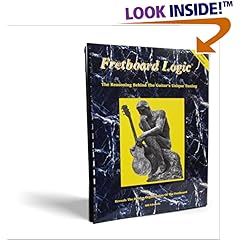 . It runs about $10 through Amazon.
Well we all shine on--like the moon and the stars and the sun.
-- John Lennon