
Notifications
Clear all
Topic starter
02/12/2010 7:28 pm
I guess this is more of a rant or observation than anything else but I am curious about this. As I only took up playing in my mid forties I decided to spend pretty much all of my time learning how to play and I guess I have done that to some degree. I mean I've learned a couple hundred or so songs over the past few years and have recently been getting much better at playing all of a song including solo's which I had stayed away from since I was playing in a garage band that already had a great lead guitarist so there was no real need to learn many. So I think I can safely say I am a decent player but I can't make music.
I don't mean sit down and try to write a song I'm talking about someone starting out say with a drum beat or a bass line and then adding the guitar and other instruments. Whenever I have tried to do this or jams I've seen they always invaribaly end up to be a 12 bar blues jam and that's not the spontaneous type of music I want to do but I have no clue how to do this and obviously I must be light years away from having the skills.
Is this something only experienced players can do? Does it mean the players involved would all have to be at a similar skill level to be able to make changes on the fly? Is it the ability to hear what's playing and react? Is it theory?
I'm not even sure if this makes sense or not but maybe some of you will have your own ideas?
For the most part I'm just a guy that plays covers and I'm totally OK with that and I really can't take more than one 12 bar blues jam/night. Maybe this is more like jazz improv but I'm not looking to play jazz either.
"It's all about stickin it to the man!"
It's a long way to the top if you want to rock n roll!
02/12/2010 7:40 pm
im so glad you posted that cnev because right now i have been feeling exactly the same way (at least now i know im not alone).
I am working very hard on trying to find rhythm "tricks" to make my rhythm sound more interesting. I have learned a few hendrix songs and really analysed the way he plays around chords - but when i try to use these tricks to a chord progression to make it sound good - i cant!
I guess this skill of "composition" is what makes me a guy who plays a bit of guitar instead of a guy who is a musician.
i have no answers im afraid, other than to say your definitely not alone :oops:
"I like to play that guitar. I have to stare at it while I'm playing it because I'm not very good at playing it."
Noel Gallagher (who took the words right out of my mouth)
02/12/2010 7:48 pm
When you create music spontaneously in the way you're describing, there's no road map. Without knowing where you're going, you need really big ears... you'd need to 1) hear that the chord has changed, 2) figure out what the new chord is, 3) understand how that chord works - or doesn't - against the line you're playing, and 4) adjust your melody accordingly. So it's a combination of ear training/music theory/quick thinking/experience, and the vast majority of musicians - heck, even the vast majority of professionals - can't do it. I can count on one hand the number of times I've seen pro jazz musicians do it. And for the most part, even the big 'jam bands' didn't do it either - they knew (more or less) what the chord changes were going to be before they started a tune.
It's much easier to improvise within a framework - like the 12 bar blues. That's why blues is so common at jam sessions: everybody knows what the next chord will be, and when it will change. It takes the guesswork out of knowing what your bandmates are doing.
If you don't like doing blues jams, but you want to gain experience in improvising, why not try using a different chord progression? There are plenty out there, from simple things like a I-vi-IV-V (the 'do-wop' progression) to more complicated ones like the 'rhythm changes' (from the Gershwin song "I Got Rhythm") or the 'Coletrane changes'. And although those are from jazz standards, you don't have to take a jazzy approach to the chords. You can take any song, and just use the chord progression as a basis for group improvisation - as long as everyone knows what those changes will be.
If you don't like the idea of taking a song, pick a song and change things around. Playing the chords in reverse order works for many tunes. And as long as everyone knows the progression that's going to be used, it's not much harder than playing a blues tune.
Guitar teacher offering lessons in Plainfield IL
02/12/2010 7:53 pm
OK, from where I sit, if you're playing an instrument you're making music - playing music means turning on the radio, or putting a CD in the player.
I guess the bottom line is you're stuck in a rut.
You say you don't want to write songs, but I think you could get a lot out of it if you meet the situation halfway. If you want to get away from the same old 12 bars, then you need to offer an alternative. Pick a key.
What I'd suggest is that you come up with a 16-bar sequence using not less than four chords - let's imagine you start with C-Am-F-G (just notice that Tom refers to this too - it's his do-wop progression.) Dave Grohl loves major->minor7 progressions so swap the Am for Am7; chord ii is a good substitute for IV, so replace the F with a Dm, and why not throw in a Gsus4 before the cadence point to add some interest. All of a sudden you've got
C-Am7-Dm-Gsus4 - and if you resolve the suspension within the bar you've got something a little more funky -
C/// | Am7/// | Dm/// | Gsus4/G/ | - play it four times and you have a 16-bar verse.
Put the F back instead of the Dm in bars 7 and 15 (yee- ha! preparing the suspension - my Uni tutor who took me through Baroque harmony would love me for this) or even play | Dm//Dm7 | in that bar.
Solo over it using the Major pentatonic and I reckon you've got something workable that's not stuck where you don't want to be.
Take it along to rehearsal. And see how it goes. The bass player can comp along using roots and 5ths until he gets the hang of it.
Who knows? Everybody else might be just as tired as you of doing 12-bar but not know a way out of it.
A :-)
"Be good at what you can do" - Fingerbanger"
I have always felt that it is better to do what is beautiful than what is 'right'" - Eliot Fisk
Wedding music and guitar lessons in Essex. Listen at: http://www.rollmopmusic.co.uk
Topic starter
02/12/2010 8:14 pm
Ah Noteboat your first paragraph hit the nail on the head. I kinda of figured it would take at the minimum a big set of ears and a fair amount of theory to be able to digest what's going on, on the fly and react to it. So that's not going to happen anytime soon with me.
You kind of also confirmed my thinking on 12 bar blues and the framework that it provides which makes the jams easier but to me that's what brings in the boredom. To me every blues jam ends up sounding the same and it gets old real quick. I go to some open mics an there is usually a couple of these every night and there is one guy that can play anything one of the best guys I've seen in CT but even after hearing him solo for a couple minutes it gets old to me after awhile it's worse than hearing some shredders play 10,000 notes as fast as they can. To me solo's are good when they have something to say and say it and then end it, the solos that go on and on are just musical meusia.
I had seen some of your other posts where you had mentioned playing a song backwards but I have not gotten around to trying it ever.
Alan I've thought about similar things that you mention but again I've never tried them but I need to sit down and read through your post a few times and maybe try things out.
As for stuck in a rut yes and no. I am still learning new songs/techniques every week but yes I guess you can call it a rut as I want to move on to do other things than JUST play covers. I'll never stop learning songs etc but I need some new ideas to explore.
Alman - As the solo guitarist in your band you have alot more pressure than I do although maybe the only difference is you do have a bit of a framework to work with since you already have a set list for your gigs so you know what tunes and what the progressions are you just want to spice them up. I'd like to do that and also create some spontaneous non-12 bar blues music if possible.
"It's all about stickin it to the man!"
It's a long way to the top if you want to rock n roll!
03/12/2010 4:17 am
I don't jam very often and haven't done anything 12 bar related in ages so I forgot how to do it but I do have some thoughts on how to make your jams and songs sound different. Best thing is not to be afraid to experiment. Break a few traditions. Take the 12 bar blues for example. 12 bars, standard tuning, common time, 1 chord per par. Play it in an open tuning. Have someone get a slide out and play the chords that way. Instead of one chord per bar, use ornaments. For example, instead of strumming D major a whole bar, change between D Dsus2 and Dsus4 every couple of strums. Try a different time signature like 3/4 or 6/8. It won't sound anything like the blues but you may be surprised by the results. I tried this once in powertab and got this:
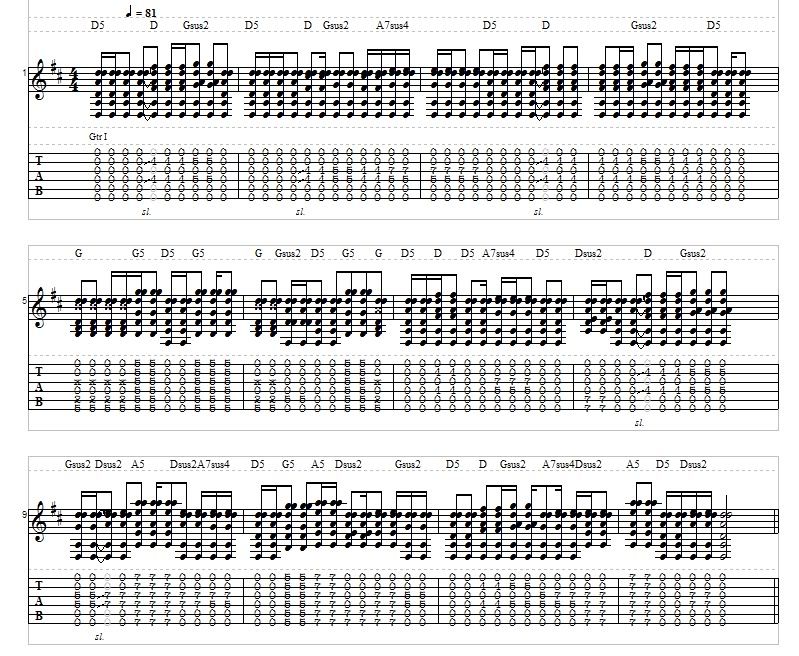
I no longer have this file in powertab and can't hold a guitar right now so I don't remember exactly what it sounds like but it definitely isn't the blues.
"In what, twisted universe does mastering Eddie Van Halen's two handed arpeggio technique count as ABSOLUTELY NOTHING?!" - Dr Gregory House
03/12/2010 2:01 pm
Chris, do you remember the loop stations thread? I bought it mainly to play over the chords. I do as Noteboat describes. Sometimes I play over blues progressions but mainly I use simple ones (the 'do-wop', a ii-V-I or just progressions with a couple of chords like ii-iii). I use pentatonic scales but also major and minor scales. I check if my playing sounds good over the changes and also I try to include some ideas from theory.
03/12/2010 2:31 pm
spontaneous non-12 bar blues music
That's what I'm looking for, as well.
I'm a noodler. I enjoy having the guitar in my lap & improvising a soundtrack for the news on NPR. Noodling is true spontaneity -- no chords to follow, just reacting to the environment. It's possible to noodle musically, if you pay attention to what you're doing. (I have a pretty broad definition of what is "musical," but I think that's necessary if you're into spontaneous creation.)
Noodling musically with other players is my ideal performance format, even though no one else wants to hear that kind of music :) .
"You can't write a chord ugly enough to say what you want to say sometimes, so you have to rely on a giraffe filled with whipped cream." - Frank Zappa
Topic starter
03/12/2010 2:41 pm
Crow,
I hear what you are saying and I would agree. I don't do enough of that sort of stuff myself. i don't want noodling to be my primary choice of music I do still enjoy playing songs that I've loved to hear but I don't want to jam to 12 bar blues very much. I can't say I won't do it I'd just prefer not to because after the first 5 mins it's all the same. Even when I hear really good players doing it I get the same blah feeling it doesn't do anything for me puts me to sleep.
Now spantaneous noodling like Noteboat mentioned in a group setting would probably be very difficult with out very trained musicians which I am not. So maybe this isn't something I can ever do but I will have to try some of Noteboats, Alan and Nuno's suggestions and at least try to move a little outside the box.
"It's all about stickin it to the man!"
It's a long way to the top if you want to rock n roll!
05/12/2010 6:01 pm
all that stuff comes from the same place. the only way to spontaneously make music... is to spontaneously make music. you just have to start doing it. start making something up. start playing whatever you hear in your head, or hum something and play it, or just let your fingers go where they want to, or whatever works for you. like everything else, it'll probably be rough for a while, but the more you work at it, the easier it will become.
one way to make the transition is to take something you already know how to play, and add some flavor to it. licks, different rhythms, tempos, keys, song styles, etc. explore any silly idea you think of. the idea is to get you to become comfortable playing from inside on the fly. keep changing little bits and blobs and, pretty soon, you're playing something totally original.
like it's been mentioned before, one the appeal of the 12 bar blues is that everyone has a shared base to work from, but jazz musicians also jam over the same old standards, and ira gershwin and miles davis sound nothing alike. in fact, almost every genre of music has its basic forms that everyone relies on. bluegrass jams over the same progressions, rap flows over the same beats, tons of song have the same foundations as each other. it's what makes music recognizable and not just random noise.
what you do is, you learn the form, you learn how to play around within the form, and then you get bored and play around with the form itself... and that's where creativity comes in to play. changing it around so that instead of playing to a style, you're using the tools you learn in the style to express yourself. it really doesn't matter that much where you start, although it's obvious that the more you learn, the more tools you have to work with, and all those songs you've learned is a great place to start from. what matters is where you take it.
another trick is to take a theme or idea and expand on it. beethoven's 5th is basically just a riff he explored, to name probably the most obvious example. instead of warming up by playing scales up and down, if that's what you do, play melodies within the scale. use it to make music. explore the whole neck. take shapes you know and mess with them. attack chords, strings, melodies, etc, with whatever style comes to mind.
another trick, and this is works great for me, is that if you feel like you're out of ideas, just keep improvising until your mind wanders away while your hands keep going. it's not always easy, because sometimes it takes a while to get through all the backlog of ingrained riffs and ideas you've beaten into the ground, but if i just keep chugging at it, eventually i stop thinking about what i'm doing and stop directing my hands, and at that point my mind goes still or wanders off to girls i've known or something in my life or whatever and i am no longer consciously directing my hands. it's not a conscious decision to get to that point. up to that point, i'm paying attention to what i'm doing. it's just that i can't focus indefinitely on the same old stuff and my mind drifts. after a bit of woolgathering, though, there's almost invariably a moment where i snap out of my reverie and go "holy ****! did that just come from me?", and sometimes "how did i just do that?", and once you start having those moments, you're hooked. you're a musician for life.
long rant. basically, just start improvising. nothing to it but to do it.
07/12/2010 6:48 am
A couple of thoughts-
One- if you can play hundreds of songs, you are doing really well, and you have a great basis for new stuff.
Two- you only get good at the things that you practice. If you've been practicing covers, and a little 12 bar blues improv, no wonder that's most of what you can do.
You won't get the "big ears" noteboat is talking about over night.
To start improv-ing right away, though, just remember that a framework is what you need. Prepare some things- with the guys I jam with, what we usually do in the last part of practice is jam, but over a riff or partial song that somebody has already written. So one guys says- the chords are Gmajor, Dmajor, Cmajor, Fsharpminor, and Aminor. And it goes like this- plays his "framework" for us a couple of times. He goes through it again, and the drummer, who has heard the rhythm a few times now, starts to add something. As we figure out where it's going, we all jump in.
It's a slow process. It isn't performance, though it might lead to performance somewhere down the road. In the early stages, it allows for a lot of "that sucked. Everybody stop. Let's start again. What were you doing on lead there? Where was the bass? How many beats is the second chord? Would a bit of E minor fit in here? Are we all in the same tuning???" and similar conversations. But it's a step in the process.
Best,
Ande
08/12/2010 3:24 am
I think people like Jimi Hendrix and Stevie Ray Vaughan made up their own music instead of playing other peoples music that way they will have their own sound.
08/12/2010 4:28 pm
I think people like Jimi Hendrix and Stevie Ray Vaughan made up their own music instead of playing other peoples music that way they will have their own sound.
Actually, a lot of their stuff was written by someone else.
They just took it places the writer never intended, and made it their own.
That's making music.
I wrapped a newspaper ’round my head
So I looked like I was deep